Showing posts with label Photo Gear. Show all posts

Thursday, January 31, 2008

Another Firmware Update For The Sony A700


This utility updates the DSLR-A700 Camera Firmware to version 3 and provides the following benefits:

Benefits over firmware version 2:

  • Resolves an issue where the Access Lamp remains lit and the camera stops responding when several pictures are taken in rapid succession.
  • Resolves an issue where powering the camera off while in "MR" mode may cause some registered settings to carry over to other shooting modes.

Additional benefits over other firmware versions:

  • Sharper images for pictures taken under low contrast conditions
  • Reduced noise for pictures taken at ISO 3200
  • Improved flash control for objects closer than 1 meter with non ADI controlled lenses

Wednesday, January 30, 2008

New Sony Zooms

Sony has just announced two new alpha-mount zoom lenses.

One is the Carl Zeiss Vario Sonnar T* 24-70mm f/2.8 ZA. which should be perfect for landscape and portrait photography. It is said that this lens exhibits excellent contrast and center-to-edge resolution. Really appealing is the fact that it's f/2.8 aperture will remain constant throughout it's focal length. Also, this lens is the only compatible large aperture standard zoom with the benefit of image stabilization available in the industry.

The other lens is a 70-300mm f/4.5-5.6 which should be ideal for ideal for sports and portrait photography. The lens offers superb contrast and sharpness across its focal length range. It is said to maintain excellent optical characteristics from center to it's periphery.

Both lenses feature Sony's Super Sonic wave motor (SSM). Both lenses will be available this spring. The the SAL2470Z Vario-Sonnar T* 24-70mm f/2.8 ZA lens will be available for about $1,750 and the SAL70300G len f/4.5-5.6 lens will be available for about $800.
^

Friday, December 21, 2007

Sony A700 Conclusions - From Dpreview

Here is the final analysis from dpreviews -

Sony Alpha DSLR-A700 Review


Overall conclusion

The Alpha 700 was introduced as a complementary model to the Alpha 100; aimed more at the serious amateur and semi-professional photographer it enters a segment of the market which is buzzing with new models (EOS 40D, D300 and E-3). The A700 clearly has a lot of Minolta DNA (it's a natural successor to the popular Maxxum 7D) but also exhibits a range of development which can be attributed to the new development team that has come out of Sony's purchase of the Konica Minolta DSLR division.

Konica Minolta were the first manufacturer to put a sensor-shift Anti-Shake system into a digital SLR (again, in the 7D which shipped in early 2005), this same feature graces the A700 but has now been renamed 'Super SteadyShot', refined possibly since then but it works in exactly the same way. In our tests it worked well enough to make a difference providing somewhere between 1.0 and 1.5 stops of 'improvement' which it has to be said is somewhat less than Sony's claims.

One thing that is clear when you start shooting with the A700 is that Sony has worked hard on performance; it feels very responsive, button presses for menus or image playback occurring instantly and there's no feeling of lag when changing settings. Other performance criteria such as continuous shooting speed, buffering and write speeds were all very good, with a pretty blazing 34 MB/sec write speed with SanDisk Extreme IV cards. I should also make special mention of that new high resolution LCD monitor which really does make a difference to the whole shoot & review experience.

My primary gripes were around a couple of questionable decisions; firstly that RAW files already have noise reduction applied to them, this in effect means that the photographer can't treat RAW as the 'digital negative'. This subsequently removes the ability to successfully apply any third party noise reduction method (either now or in the future) or to make his or her own decisions about the balance between noise and NR. I understand that this is because a certain amount of noise reduction occurs very early in the image pipeline (at or around the sensor) but why that can't be simply disabled by choice is a curious to say the least.

The second oddity is the fact that this camera's base sensitivity appears to be ISO 200 (not ISO 100), subtly hinted by the fact that the Auto ISO range begins at 200 and supported by our own dynamic range tests. Sony managed to indicated that ISO sensitivities above 3200 were 'out of calibration' but not those below 200 (the trade-off below this point is highlight dynamic range). This gives rise to the rather ridiculous situation where most users (who try to stick to the lowest ISO wherever possible) will not only be shooting at a setting that doesn't produce the optimum image quality, but also losing a valuable stop of sensitivity at the same time.

With the gripes out of the way I have to say that overall image quality was very good, with the A700 producing as much resolution / detail as the competition at lower sensitivities and noise reduction keeping noise levels in check at higher sensitivities without losing too much detail (although we personally would prefer less luminance reduction and more chroma reduction, which is Nikon's approach). Color was predictable and neutral and tonal response was good without ever being over contrasty (nice roll-off in highlights from ISO 200 upwards).

Overall then the A700 is a good performer with good overall image quality with a nice range of features - even if on the negative side there are some quirky design decisions which may or may not affect you. Best of all though is the fact that it weighs in at the lower end of the price band for this category of DSLR, that makes it about $400 less than the Nikon D300 and $300 less than the Olympus E-3.

Detail (D-SLR)
Rating (out of 10)
Build quality 8.0
Ergonomics & handling 8.5
Features 9.5
Image quality 9.0
Performance (speed) 9.0
Value 8.5

Highly Recommended

Tuesday, December 11, 2007

Sony A700 Conclusions - From Imaging Resource

Here is the final analysis from Imaging Resource on the Sony Alpha A700.

With Sony's new Alpha A700, the digital SLR camera market just got even hotter. Sony and Minolta fans have needed this camera, and Sony has delivered. The Maxxum 7D was a great design worth upgrading to keep up with advancing technology, and it seems the Sony A700 will be a more than competent contender in the market. Better, our experience says it should help photographers make great images, which is more what a camera is about than doing well in some spec comparison table.

Great control placement, a good fit, new lenses and accessories combine with improvements in the AF system, noise performance, image stabilization, and overall speed to create what should be an easy choice for enthusiasts.

We're excited to get a production version so we can see what this mature design from two of the biggest names in electronics and photography can produce.


Thursday, November 01, 2007

Sony A700 Tips

Sony Has Firmware Upgrade For The A700


Sony has released an updated firmware for the DSLR-A700 camera, as well as updates for the Image Data Converter and Image Data Lightbox bundled software applications.

The camera firmware update improves image sharpness and reduces noise under certain circumstances. It also improves flash control at very short distances with non-ADI control lenses. The updates for the bundled software applications correct the functioning of such features as image display and file type indication. These updates relate only to early production Firmware �Ver.1� models, which were manufactured through early October. Firmware �Ver.2� models (press Menu & Display together to check) already include this upgrade. Although these improvements are subtle, it is recommended that customers make the update to improve the camera and application software performance.

Sunday, October 14, 2007

Sony A700's D-Range Optimizer

There are many new features and specs I was anxious to upgrade to with the new Sony A700, not the least of which was the D-Range Optimizer. The D-Range Optimizer automatically prevents loss of detail in dark shadow or bright highlight areas in strongly backlit or high contrast scenes. Although, somewhat skeptical of getting usable results with this feature, I believed it would be amazingly useful if it did work as intended. Imagine not having to dig out and work with filters or painstakingly have to rely on post-processing to save a picture whose exposure values were just too wide. After playing with the other various controls and features on the A700 (for a little bit), I decided to concentrate specifically on the D-Range Optimizer. As I'm sure most have figured out already, the D-Range stands for Dynamic Range and getting all the values properly exposed in certain photos with a large range has long been a pain for photographers. Let us see how the A700 handles such situations.


I chose a typical indoor scene which usually spells trouble for the camera trying to obtain proper exposure across the whole range. The scene has one standing in an interior shooting towards a window with bright sunlight. The view is wide enough to include much of the interior surrounding and in front of the window. Predictably, if we expose for the sunlight the rest of the scene goes very dark, as shown in the first shot above.

This was the first shot I took using the Optimizer and was meant to show how the scene would record using the camera's default value. Although, I thought this setting would be what the Sony labels (D-R) or the standard setting, somehow it wound up being (D-R+) or what Sony calls the Advanced Auto Setting.


Later on, I figured out how to change the setting to standard or (D-R), which was very easy to do actually. And this setting is represented above.


So then, for comparative purposes, I thought I would capture the scene using the camera's built-in flash and this is what we see here.


Now, on to the fun stuff. Sony's Advanced Level D-Range Optimization can be utilized through a five-step range, depending on the needs at the time.

Here is the scene recorded at Level 1.


Same scene at level 2.


Here is a Level 3 shot.


A shot at Level 4.


Here is Level 5, the highest setting.

I'll let everyone be their own judge here, as to the usefulness of this feature. It plainly did lighten up the shadows and expand the range of light values. Tell me what you think.


NOTE: To keep comparisons as accurate as possible, all shots in this post are presented with no post processing except to downsize them for web use. Notice even my typical copyright is not present.

^

Thursday, October 11, 2007

My New A700 Arrived


I arrived home from work yesterday to find my new baby waiting on me. My A700 has arrived safe and sound. I ordered it directly from Sony on Monday and received it yesterday, as I stated, with no special shipping. I was way too tired to try it out after a 17+ hour shift, so I will see what it offers today. I can tell you from the two minutes I did spend with it that the screen is awesome and beyond compare. Amazing! I can't post any further now as I must finally check out the new camera.

If you need a review of this camera
check out dpreview , Steve's Digicams, or imaging resource.
^

Tuesday, September 18, 2007

Corel Announces Paint Shop Pro Photo X2

Wow, well I was on hiatus from computing in general and blogging specifically, Corel snuck one in on me! Their newest version is entitled Corel Paint Shop Pro Photo X2. Could they make the title any longer?

This version offers an 'Express Lab' where one can supposedly edit dozens of photos in the time it used to take to edit just a few, partially because you don't have to wait for each individual photo to open. The new interface has gone dark, which seems to be the current rage in software (at least photo software). An exciting new feature is the ability to create HDR images and I'm looking forward to trying this out. There are now, also, new styles for layering ( whatever this means) and the ability to create visible watermarks. There is a new make up tool called 'Thinify', which just seems silly to me and several other program enhancements.

I can't wait to download the trial version and start putting this new program to the test. Hey, I guess I'll do that now.

Sunday, September 09, 2007

Sony A700 Finally Arrives

Now that Sony has finally announced the release of the A700, I am compelled to make an announcement of my own -

To anyone who is properly concerned, if you are willing to send me this new camera please contact me for my shipping address. She will be graciously accepted and used frequently. I will provide a good home for the precious A700 and give her all the care and support she so truly deserves.

Tomorrow is my brother's birthday. Perhaps he should consider buying me this camera for his birthday? It would make a great gift.


Tuesday, July 17, 2007

Quick Release Arrives

I came home from work this morning and found a Slik Quick Release on my porch. I guess B&H was now able to get one to me. I mounted it on my camera and tripod and it seems plenty sturdy. It is already very, obvious that it will be extremely useful. I should have bought a release years ago.

Now, I must test it for a while. If it is everything I expect it to be then I will acquire another set. The second set will allow me to mount my 400mm lens directly and the female piece will go on my window pod setup. Wow, that will truly be convenient.

Tuesday, July 10, 2007

Still Trying to Obtain a Quick Release


Sadly, I'm still searching for a quick release for my Slik Ball Head. After much investigating on many photography forums, I came away somewhat confused. Different releases for different folks, I guess. At any rate, I finally decided on the Slick DG-L Quick Release. I was getting conflicting info on the forums, so I simple chose a matching release from Slik after talking to a rep from THK Photo Products. They recommended I order the DQ-L Quick-Release Adapter Set from B&H Photo.

So, about last Saturday, I broke down and tried to place an order for the quick release set. B&H said the product was not currently in stock. Bummer. Then, Monday I receive an email from B&H and they said the product was now in stock. They encouraged me to resubmit my order, which I immediately did. Today, B&H sends me another email stating -

"We regret to inform you that due to a system error the ordered merchandise is not in stock.

We apologize for this inconvenience"

There seems to be no other U.S. supplier I can order this from. I found a supplier from the U.K. but, was hoping to order from the U.S., thinking shipping would be much more reasonable. I guess I am still on the trek in search of a quick release for my ball head!


Monday, July 02, 2007

Manfrotto 055PROB


I've been wanting (needing) a new tripod for some time now. I have owned a Bogen 3021 for many years and it is starting to fail me. The legs simply will not hold position any longer. True, you are supposed to be able to tighten them but, I have not had any luck with this. If I tighten them enough so the legs will hold - they WILL hold and then they are too tight to loosen. If I back off the tension just slightly they will not hold at all (two out of the three legs). I can't seem to get the right tension no matter how much time I have dedicated to curing this problem.

So, today, I purchased the Manfrotto 055PROB Tripod which is essentially the same as the Bogen 3021 BPRO Tripod. The Bogen is simply the U.S. version. There are no differences between the current 3021 and the 055PROB. What I don't understand, though, is how the current 3021 and the older 3021 share the same model number. They are two very, different animals to me.

The new 3021 has a slightly different design to it's leg locks and it appears to be better. The tubing in the newer version has an anti-rotation design which the other lacks and I feel this is a HUGE improvement. The head design is totally different. There is a bubble level in the new design which the other lacks. The new Bogen comes with two(2) foam leg warmers (why not three?) while the older has none. The most obvious difference is in the center column functionality. The new tripod has a feature which allows for the repositioning of the center column into a horizontal orientation. I believe this feature is totally unique to Manfrotto/Bogen.

By enabling the center column to be horizontal, in combination with the ability to spread the legs so far, one can essential position their camera at ground level. The camera would not be upside down in this configuration, which is a common solution with most set-ups.

I chose this tripod without a head of any kind. This is because I purchased a new ball head a while ago, which I am totally dedicated to. I think the Slik SBH-550 Ball Head and the Manfrotto/Bogen Tripod will be an awesome combination. The only thing lacking in my support needs now, will be in a good quick release system. I still haven't found a quick release but, it is high on my list. If anyone has any suggestions for a good QR system, please let me know.

Friday, May 11, 2007

Worlds Largest Non-Military Lens


The Zeiss Apo Sonnar T* was designed by Carl Zeiss to be the world's largest nonmilitary camera lens. The 1,700mm lens weighs more than 550 pounds, is larger than a refrigerator, and gives a medium-format camera a telephoto factor of almost 29X. Don't expect to actually see it in the wild anytime soon, though; the Apo Sonnar T* is a special project from Carl Zeiss and costs as much as a small house.

Never before has the world of photography seen such a lens. The ZEISS Apo Sonnar T* 4/1700 was developed by Carl Zeiss for a customer with very high demands and a special interest in long distance wildlife photography. To achieve the highest possible image quality, the customer decided on the Hasselblad 203FE 6x6cm medium format camera and ZEISS lenses as the best combination for his special needs.

At a focal length of 1700mm and a speed of f/4, this project even challenged the manufacture of the optical glass. The delicate, special glass types required for this unique design had never been cast before in such huge dimensions. Some of the resulting lens blanks weighed more than 25 kg (55 lbs.) and were valued more than a luxury sedan! Turning these blanks into the finished lens elements added even more to their value.

The design of the ZEISS Apo Sonnar T* 4/1700 required new lens assembly techniques and quality assurance methods never before applied in photo lens production – even by Carl Zeiss’ normally high standards. The finished lens weighs a staggering 256 kg (564 lbs.), placing unique demands on the focusing mechanisms. To address this issue, Carl Zeiss developed a totally new way of operating a telephoto lens, including servo controlled aiming and focusing systems like those used in large telescopes and similar instruments for astronomical scientists.

Drawing from its expertise in developing and producing satellite and space optics, as well as ultra-high resolution microlithography lenses for semiconductor fabrication, Carl Zeiss was happy to accept this challenge.

The resulting Carl Zeiss Apo Sonnar T* 4/1700 lens consists of 15 optical elements in 13 groups. It is the largest telephoto lens ever produced for civilian photographic purposes and a testament to the precision design and manufacturing capabilities at Carl Zeiss.

Photo: Apo Sonnar T* 4/1700: the largest tele lens for non-military applications across the globe.

One must wonder what the military is using?

For those who are interested, you will probably need to fabricate some kind of adapter to mount this animal to your cell phone. Good luck.

Thursday, May 10, 2007

Tamron 18-250mm Lens


The Tamron 18-250mm f3.5-6.3 Di II Macro is currently the lens with the largest zoom rate to date. It has a zoom ratio of 13.9 and it's effective equivilent for an APS-C camera (for which it is specifically designed) would be 27-375mm. It has a suggested street price of $499.

It is compact and light weighing only 15.2 ozs. It has a filter size of 62mm. It is available in the Canon AF, Nikon AF-D, Pentax AF, Samsung AF, Sony/Maxxum AF-D mounts.

Thursday, April 05, 2007

My NEW Wider Lens


I received my new lens this afternoon. This lens will give me the much needed lower focal lengths, I have been looking for. I have had nothing at the shorter length since I replaced my non-digital equipment. This was especially important because my camera today has an ASP-C sensor. Sure, it might not be the 'best' lens but, it will get me in the lower end today and perhaps I can find something faster in the future. In the future I will even go wider and I can worry about speed and other factors then. In the mean time this fills a gap and I will put it to good use.

Konica Minolta AF DT Zoom 18-70mm lens : As the new standard for digital SLR cameras, DT lenses are ideally suited to digital SLR cameras such as the Konica Minolta Dynax 7D and Dynax 5D that are equipped with APS-C sized (23.5x15.7mm) CCD’s. The Konica Minolta AF DT Zoom 18-70mm lens will be available in September 2005. The Konica Minolta Dynax 5D uses an optical system ideally suited to a APS-C sized (23.5 x 15.7 mm) CCD, in addition to spherical lenses to reduce spherical aberrations, AD (anomalous dispersion) glass, and a special lens coating that reduces flare that can occur in digital SLR cameras. Effective Anti-Shake compensation equivalent to a shutter speed 2 - 3 stops slower with Dynax digital SLR camera.
Konica Minolta AF DT Zoom 18-70mm lensKonica Minolta - ADI flash metering
Using information obtained from the lens’ built-in distance encoder, Advanced Distance Integration (ADI) flash metering calculates the optimum exposure settings and flash brightness needed to obtain a beautiful image when using either the internal flash or external flash units such as the Konica Minolta Program Flash 5600HS(D) or 3600HS(D), and 2500(D). A round aperture makes it possible to enhance a defocused image with smooth grada- tions and depict a scene naturally, for example, sunshine filtering through foliage or grass glistening with morning dew.

Konica Minolta AF DT Zoom 18-70mm specifications
- Focal length: 18-70mm
- Angle of view: 76° (18mm) - 23° (70mm)
- Aperture: Maximum: f/3.5(18mm) - 5.6 (70mm) Minimum: f/22(18mm)-36(70mm)
- Blades: 7-blade circular
- Optics: Construction: 11 elements in 9 groups
- Includes one AD (anomalous dispersion) glass elements and one Aspheric element.
- Focusing: AF motor: Camera body (coupler)
- Method: Front focusing
- Minimum focus distance: 0.38m
- Maximum magnification: 1/4
- Filter diameter: 55mm
- Lens hood: Petal-type hood with bayonet mount
- Dimensions: 66 (dia.) x 77 (length) mm
- Weight: 240g
- Lens mount: Minolta A mount
- Standard accessories: Front cap, Rear cap, Lens hood
- Optional accessory: Soft case.

Tuesday, March 06, 2007

Slik SBH Ball Heads


While searching the internet for a suitable quick release system for my camera supports, I was reminded how happy and impressed I was with my tripod ball head. So, I decided to do a little review of the head to assist those who may be looking for a stout, reliable, easy to use ball head.

I use the Slik SBH Ball Heads and am extremely happy with their build and performance. These heads are part of Slik's professional series. They come in three (3) sizes. The SBH-280, SBH-320, and the SBH-550 the largest of which will carry a load of up to 22 pounds. I currently use the 550 on my main tripod and I have a 320 on order for a window pod I got last Christmas. I can't wait until it gets here. Now if I could only decide on a suitable Quick Release for these amazing heads. If anyone has experience with a reliable quick release system, please, let me know. Whatever the QR system used (if any), I am convinced these heads are the best value for your dollar.

Besides being extremely well built and reliable what I really love is their design. They all operate flawlessly with a SINGLE oversized knob. When the head is released, not only does the ball portion of the head move freely, the main body encasing the head can turn on its base for quick and easy movement as well. This design makes it the most easy to use ball head ever! I highly recomend one of these great heads.

Wednesday, October 18, 2006

Who Wants A Sigmonster ?


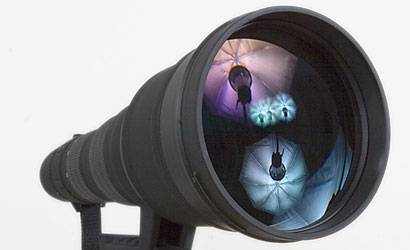
The Sigma 300-800 f/5.6 EX APO HSM AF is the longest zoom lens for the 35mm format. It is, also, the heaviest at 12.9 pounds. Ouch. This toy even focuses down to an amazing twenty (20) feet.

So, who wants one?

Ah, did I mention, it will take $6,200. (street price) to get one in your camera bag. Is your bag big enough? Is your wallet?

Wednesday, August 16, 2006

My New Lowepro Mini Trekker AW


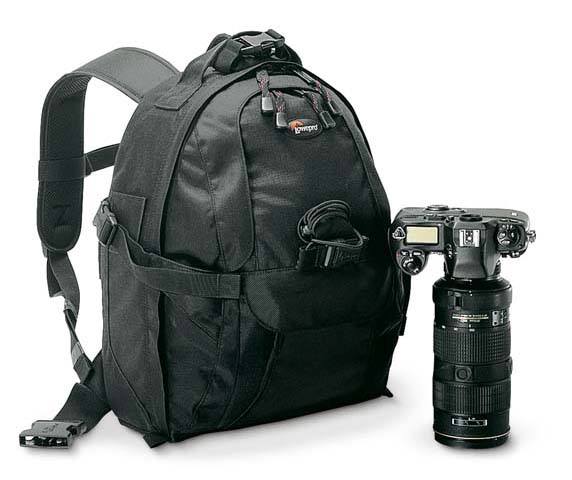
I just received the Lowepro Mini Trekker AW for my birthday/anniversary. Unlike the photo, my pack is forest green and black. It is lightweight, compact and holds a surprising amount of gear. It includes an integrated quick-release tripod holder, attachment loops for optional accessories, compression straps and lots of pockets (you can never have enough pockets). The ergonomic harness features wide, padded shoulder straps and a sternum strap.

This pack was desperately needed. When I sold my non-digital gear I, also, sold all my camera cases except my Pelican hard case. You don't know how much you need something until it's gone. I will put this new pack to good use.

My wife surprised me here. Not so much that she purchased this for me but, because of her attitude when we were picking it out. It was a complete role-reversal for us. She kept trying to get me to choose a more expensive model. I did not want the other pack. The other case had a pull-out handle and wheels on the bottom, much like some luggage in use today. I had no desire for this 'rolling' feature. This other pack held more gear and her logic, I guess, was quite simple. She is afraid that I will outgrow the Mini Trekker before too long and would then press her for the purchase of a new camera bag. "Better to by the larger one now than to have to purchase a second one later", she stated. I understand her thinking, but very much preferred the Mini Trekker. Like I said, this is a complete role-reversal as I am always trying to entice her into the better (albeit more expensive) items.

I worry, not so much in the outgrowing of my camera pack but, in it's overall usage. You see, I am more likely to desire another bag based on it's usage for a given task. I have had many camera cases over the years and 'usually' purchased another case because it was more functional in some way. Over these years, I have found out that there is no such thing as the perfect camera gear carrying system. If one item excels at something - it's competitor excels in some other area. If anyone finds a perfect system - let me know. In the mean time - I will enjoy my new Mini Trekker.

Monday, July 10, 2006

Second Attempt With Monolight

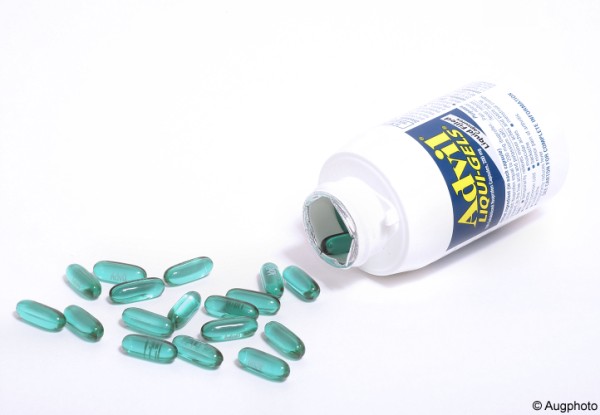
A second attempt at my 'Advil' still-life. It only tells me I have a long way to go! See my very, first try here.